US-DATAData Annotation
Cabinet
We prepare camera video and images for Computer Vision training — people and vehicle detection, object tracking, events, zones and complex scenes. From a pilot to a production-ready dataset.
Calculate project cost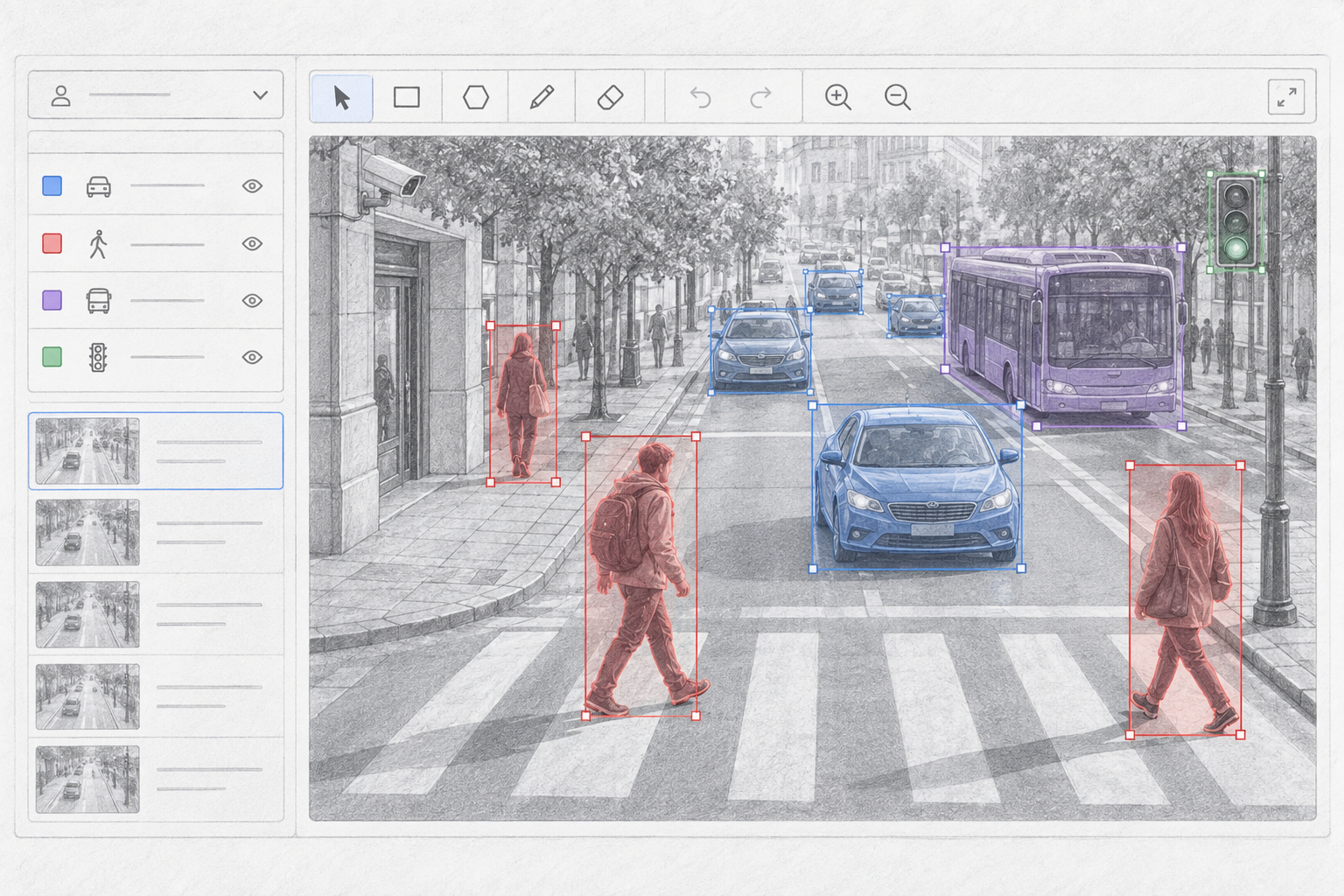
Data annotation for video surveillance is the preparation of camera images and video streams for computer vision training. Annotators mark people, vehicles, objects, zones and events, and track how objects move across consecutive frames.
Unlike work with separate photos, surveillance requires the temporal link between frames. The same person or car must keep a correct ID while moving, when partly occluded, or when scale and viewpoint change.
These datasets have to reflect real camera conditions: low light, shadows, rain and snow, crowded frames, distant views, motion blur and partial occlusions.
The model then receives structured data for training automatic video analytics, security and monitoring systems.
Bounding boxes, polygons or masks for people, cars, bicycles, items and other objects in the frame.
Video Object Tracking that keeps a unique object ID across frames and follows its motion.
Controlled areas, crossing lines, movement directions and object trajectories.
Entry and exit, falls, object appearance, stops, crowds and other specified events.
Extra attributes: vehicle type, object category, scene state or other project parameters.
Occlusions, small objects, night video, unusual angles and dense flows of people and traffic.
Different annotation types for computer vision tasks
Full data preparation cycle from raw data to model-ready output

How US-DATA keeps video annotation stable
For surveillance it is not enough to mark an object on a single frame. An error can appear during motion, occlusion or a change in shooting conditions and then affect the whole track.
Annotation follows shared guidelines, and results pass multi-step review. We check object position, consistency between frames, ID correctness and the rules for hard cases.
The process and review criteria are adapted to the task, camera type, object classes and the specific ML model.
We understand how annotation quality affects detection, tracking and real video scenes.
Dense scenes, occlusions, small objects, varied angles and hard shooting conditions.
Start with a test sample and scale to large image and video volumes.
We follow your guidelines or help define rules for the model.
Multi-step QA and one standard for the whole dataset.
More accurate object detection
Stable tracking between frames
Fewer false alerts
Reliable work on complex video scenes
A dataset ready for training and production
Expandable sections with indicative cost tables.
Choose parameters and get instant estimate
* This estimate is not a public offer. Final cost is determined after technical analysis and data review.
Latest materials on data annotation and machine learning
Send a request — we will estimate the volume, annotation requirements and the best approach for your ML task.
Data annotation for video surveillance is a key step in preparing datasets for computer vision and automatic video analytics. A neural network needs a large volume of carefully labeled images and video to detect people, vehicles and other objects, follow their movement and recognize events.
US-DATA annotates video data for surveillance, security and Computer Vision. We work with single frames and video sequences, perform object detection, bounding boxes, image segmentation, classification, frame-by-frame labeling and Video Object Tracking with stable IDs across frames.
Datasets for video analytics must reflect how cameras actually operate. People and vehicles overlap, sit far from the camera, appear in low light or move quickly. These cases need shared annotation rules and separate quality control, otherwise training errors turn into false alerts and unstable tracking.
US-DATA can join a pilot or a large-scale annotation program. Our own infrastructure, shared guidelines, multi-step review and specialists who understand ML and Computer Vision keep annotation consistent at volume.
If you need a surveillance dataset, video annotation for neural networks, people and vehicle detection or object tracking, US-DATA will prepare data in the agreed format for training, testing and production.