US-DATAData Annotation
Cabinet
We prepare images, video, plans and documents for AI training — object classification, facade and interior annotation, room segmentation, defect detection and catalog automation.
From a test sample to a production-ready dataset.
Calculate project cost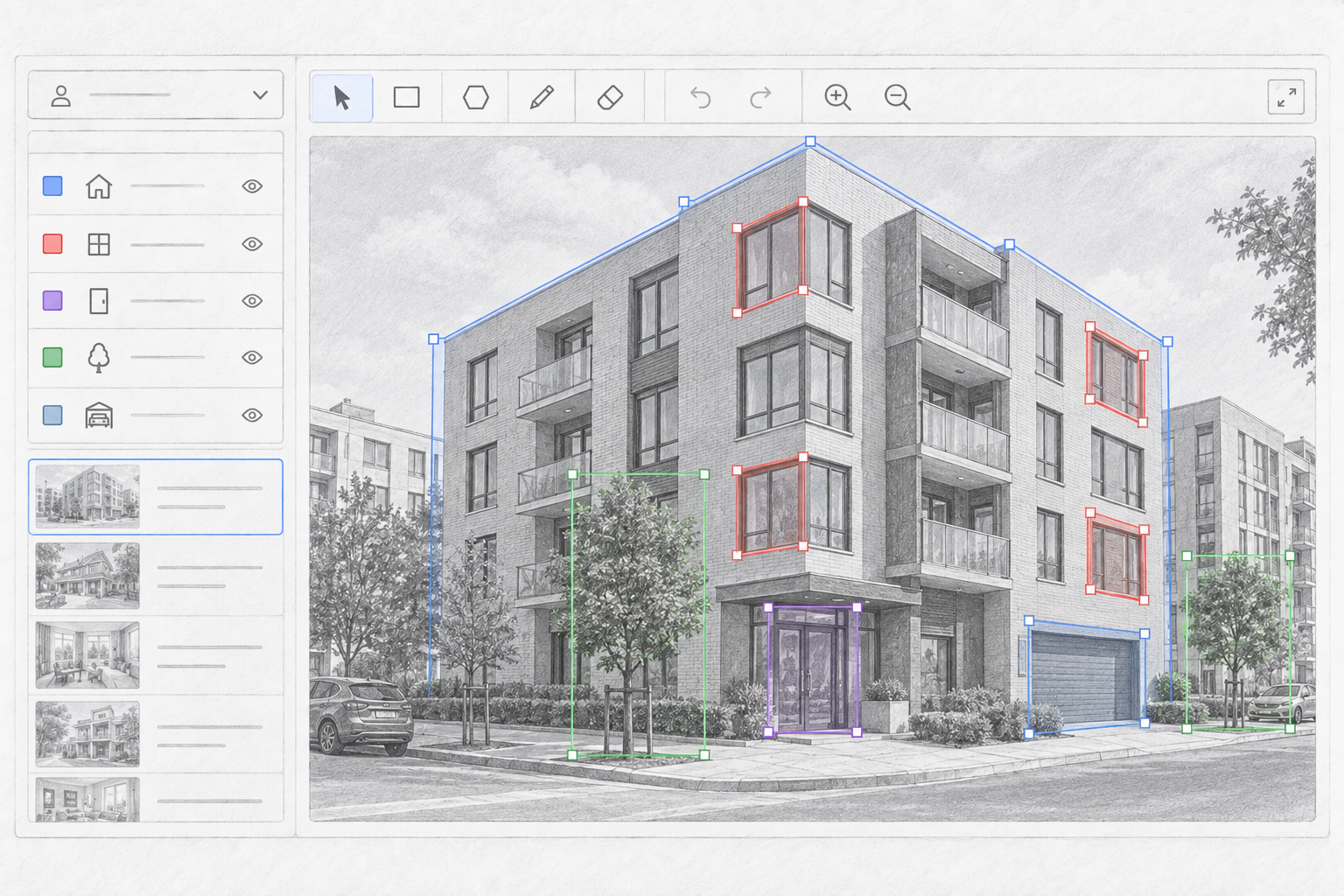
Data annotation for real estate is the preparation of photos, video, floor plans, diagrams and documents for artificial intelligence and computer vision.
Annotators can mark buildings, windows, doors, rooms, interior elements and other objects, classify images, segment zones and label defects.
These datasets are used in PropTech, classifieds, development projects, automatic valuation and technical inspection tools.
Real estate visuals vary widely. The same room type can look completely different, and building elements change with architecture, year of construction and shooting conditions.
AI training therefore needs shared annotation rules, a well-designed class structure and separate handling of hard cases.
Bounding boxes for:
Precise boundaries of:
Categories such as:
Drawings and plans:
Marking:
Data from:
Different annotation types for computer vision tasks
Full data preparation cycle from raw data to model-ready output

How we keep real estate annotation stable
Real estate data is visually diverse. One room type can appear in dozens of variants, and architectural elements differ in shape, material and position.
Before scaling we agree annotation rules, class structure and borderline cases.
Annotation passes several review levels so the same approach holds across the whole dataset.
Computer vision can analyze property photos and extract structured characteristics.
An AI model can determine:
Training such models requires a large set of annotated examples.
US-DATA helps define the class structure, prepare guidelines and annotate the required volume.
Computer vision is used not only to catalog properties, but also for technical analysis of buildings.
We can annotate:
Depending on the task we use bounding boxes, polygons or segmentation.
These datasets train automatic visual inspection and technical monitoring systems.
Photos, video, plans, diagrams and documents can be handled in one project.
We understand data requirements for detection, segmentation and classification.
We follow the customer's ontology or help formalize it.
Non-standard facades, interiors and architectural elements.
Start with a pilot and increase volume after quality is confirmed.
We control accuracy and consistency throughout the project.
More accurate property classification
Correct facade and interior recognition
Automatic property characteristics
Defect and damage detection
A dataset ready for training and testing
Expandable sections with indicative cost tables.
Choose parameters and get instant estimate
* This estimate is not a public offer. Final cost is determined after technical analysis and data review.
Latest materials on data annotation and machine learning
Share a data sample and describe the task — we will estimate the volume, suggest an annotation approach and prepare a test batch.
Artificial intelligence and computer vision are increasingly used in real estate, development and PropTech. AI models classify properties, analyze interior photos, recognize architectural elements, process floor plans and find visual building defects. Those systems need carefully annotated data.
US-DATA provides image annotation, video, plan and document labeling for real estate projects. Depending on the task we use bounding boxes, polygons, segmentation, classification and OCR.
Property photos can be annotated for buildings, rooms, windows, doors, furniture, interior and facade elements. The data supports automatic listing classification, property characteristics and computer vision training. Individual elements are found with object detection.
A separate direction is facade and defect annotation. AI models can search for cracks, damage and other visual signs of condition. These tasks especially need accurate image segmentation and shared annotation criteria.
US-DATA can also process floor plans, technical diagrams and documents. Text data annotation helps models recognize rooms, walls, doors, labels and extract structured information.
For classifieds and PropTech platforms, data annotation automates large volumes of listings and photos and improves search, recommendations and catalog structure.
US-DATA can join at any stage: a pilot, guidelines, an existing data pool, or scaling a process that already works.
If your project needs real estate data annotation, property classification, room segmentation, facade labeling or a PropTech dataset, US-DATA will prepare data in the agreed format for training, testing and further use of the ML model.