US-DATAData Annotation
Cabinet
We prepare images and video for AI training — defect detection, production-operation control, equipment recognition, industrial safety and automatic visual inspection.
From a test annotation batch to a production-ready dataset.
Calculate project cost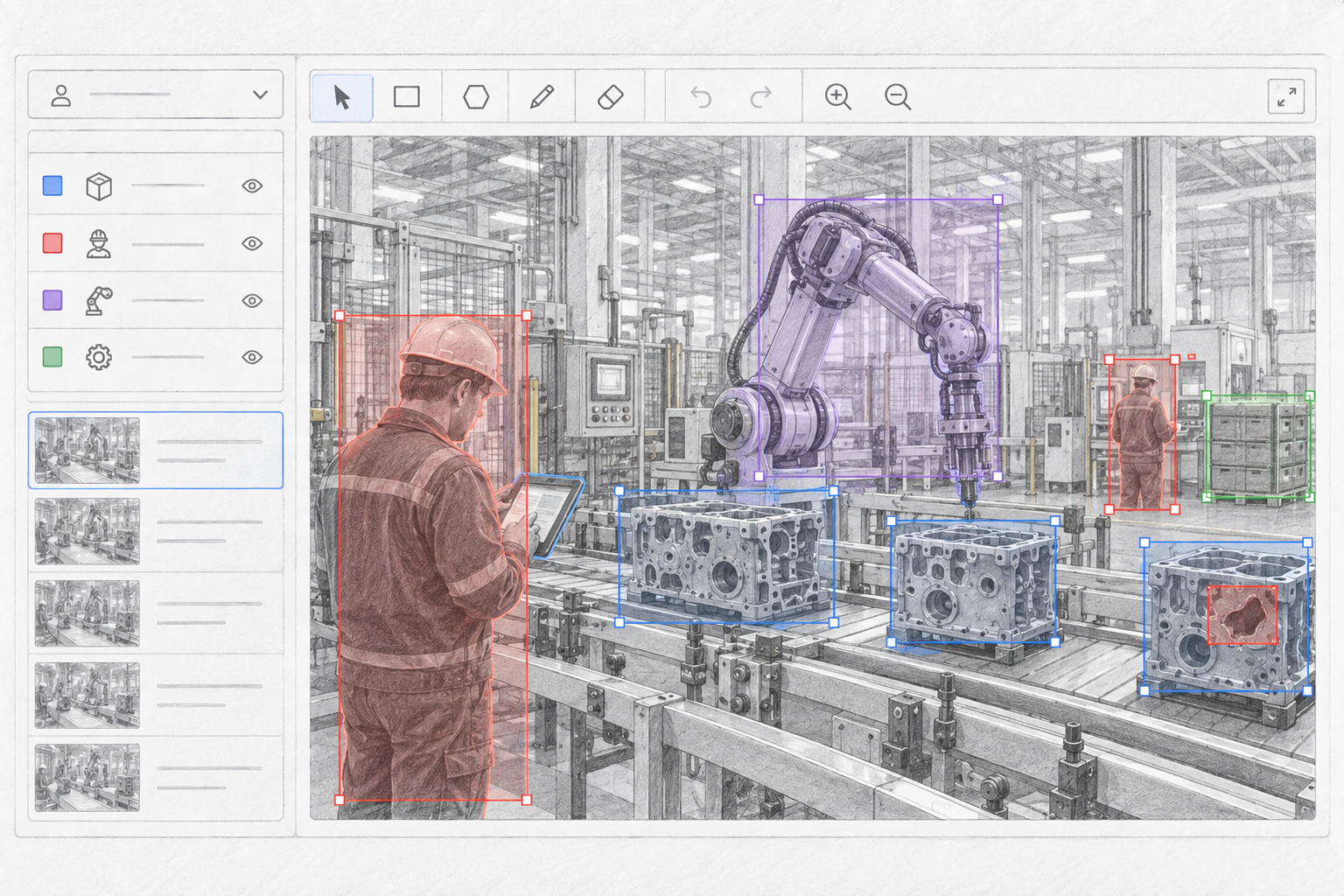
Industrial data annotation is the preparation of images, video and other materials for computer vision and machine learning systems used in manufacturing.
Annotators mark parts, equipment, people, defects, hazard zones and production events. Depending on the task we use bounding boxes, polygons, segmentation, classification and tracking.
These datasets support automatic quality control, production-line monitoring, defect detection, safety compliance and robotic systems.
Industrial projects have a high cost of error. Even a small missed defect or a wrong class can affect product quality or plant safety.
Shared annotation rules, precise work on difficult objects and separate review of rare and borderline cases therefore matter especially.
Bounding boxes for:
Precise outlines of:
Marking:
Classification of:
Tracking of:
Robotics, part pose and pose analysis can use keypoints and other specialized annotation types.
Different annotation types for computer vision tasks
Full data preparation cycle from raw data to model-ready output

How we keep industrial annotation stable
Industrial projects especially need consistent labeling of small defects, parts and production events.
Before launch we agree annotation criteria and describe borderline cases in detail.
Annotation passes several review levels. Rare defects, small objects and examples where an error would affect training get extra attention.
A core industrial Computer Vision task is automatic detection of product defects.
An AI model can search for:
Depending on the task a defect can be a bounding box, a polygon or a precise segmentation mask.
US-DATA helps define defect classes and rules for ambiguous cases so the model receives consistent data across the dataset.
Computer vision can automatically monitor production zones and staff actions.
For these systems we can annotate:
These datasets train PPE control, work-zone monitoring and warning systems for potentially dangerous situations.
Line video and images can be used not only to find defects, but to analyze the process itself.
We can annotate:
This creates datasets for AI monitoring of production processes and automated control.
We understand data requirements for detection, segmentation, classification and tracking.
We annotate small parts and defects where boundary accuracy matters.
Glare, shadows, occlusions and varied shooting conditions.
We can work in the customer's system or in an agreed annotation tool.
We start with a pilot and scale after quality is confirmed.
We control accuracy and consistency throughout the project.
More accurate defect detection
Automated visual inspection
Stable recognition of parts and equipment
Control of operations and safety
A dataset ready for training and testing
Industrial projects often involve confidential materials: production lines, internal premises, equipment, process technology and product prototypes.
Expandable sections with indicative cost tables.
Choose parameters and get instant estimate
* This estimate is not a public offer. Final cost is determined after technical analysis and data review.
Latest materials on data annotation and machine learning
Share a data sample and describe the task — we will estimate the volume, suggest the right annotation type and prepare a test batch.
Computer vision and artificial intelligence are increasingly used to automate industrial processes. AI models find defects, control product quality, analyze production lines, monitor safety requirements and automate visual inspection. Those systems need carefully prepared and annotated data.
US-DATA provides image annotation and video annotation for industrial AI projects. Depending on the task we use bounding boxes, polygons, segmentation, classification and object tracking.
A key direction is defect annotation for visual inspection. We can mark cracks, scratches, chips, deformations, corrosion, surface defects and other deviations. Small defects need precise boundaries and one annotation logic, so image segmentation is often used.
Another common scenario is production-process control. Computer vision can check whether parts are present, follow products on the line, analyze equipment and verify operation sequences. Object movement uses motion tracking.
Annotated data is also used in industrial safety. AI models can check personal protective equipment, detect employees in hazard zones and analyze how people interact with equipment. The basic way to mark an object in the frame is object detection.
Robotics and automated production cells may need datasets with objects, part pose, keypoints and motion trajectories.
US-DATA can join at any stage: a test batch, formalized requirements and classes, an existing data pool, or scaling a process that already works.
If your project needs industrial data annotation, a visual-inspection dataset, defect labeling, process control or Computer Vision data, US-DATA will prepare a dataset in the agreed format for training, testing and further use.