US-DATAData Annotation
Cabinet
We prepare calls, dialogues and voice recordings for AI training — transcription, speaker diarization, intents, sentiment, classification and dialogue annotation.
From a test sample to a dataset for speech analytics, voice assistants and contact centers.
Calculate project cost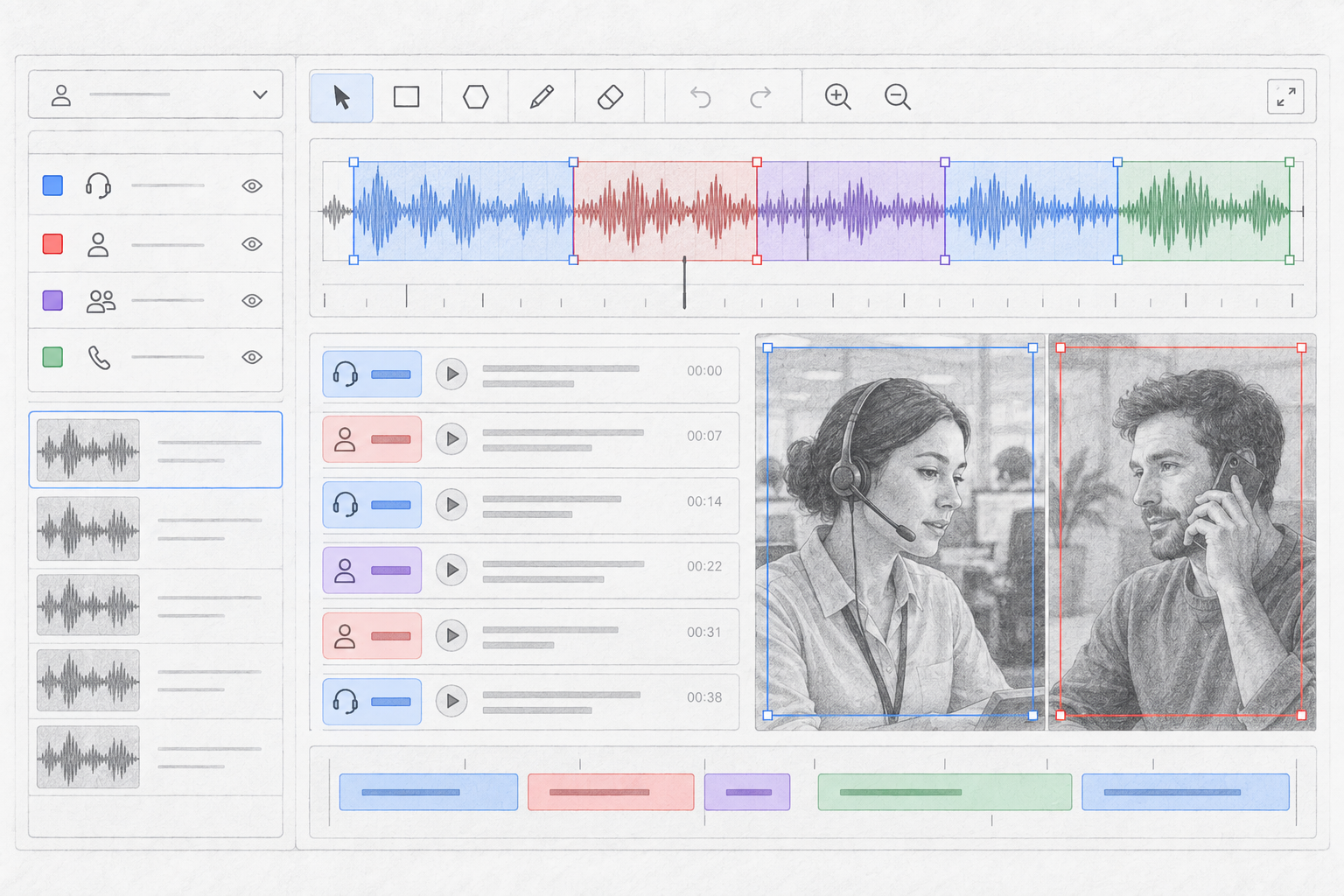
Call and voice data annotation is the preparation of recordings, transcripts and dialogues for speech recognition, speech analytics, NLP and voice assistants.
Depending on the task, a recording can be transcribed, split by speaker, divided into utterances and enriched with intents, emotions, sentiment, entities and other labels.
These datasets are used for automatic call transcription, service-quality analysis, request classification, voice bots and speech analytics.
Conversational data is natural speech. Real calls include overlaps, pauses, background noise, filler words, incomplete phrases, emotional speech and simultaneous talk.
A quality dataset therefore needs shared rules for transcription, diarization and classification.
Turning a conversation recording into text.
Splitting a conversation by participant: agent, customer, several speakers, voice bot. Each utterance or time segment gets the matching speaker.
Splitting a recording into:
The purpose of the customer's request. The intent structure is defined per project.
In dialogues:
Emotional tone of utterances or of the whole call. Categories by topic, outcome, customer type, reason and conversation scenario.
Different annotation types for computer vision tasks
Full data preparation cycle from raw data to model-ready output
How we keep call annotation consistent
Conversational speech contains many ambiguous cases: overlaps, pauses, noise, unclear fragments and incomplete sentences.
Before launch we fix rules for transcription, speaker separation, classification and disputed cases.
Annotation passes several review levels so the same situations are handled the same way across the dataset.
Speech analytics turns large volumes of unstructured speech into data.
These systems can be trained on:
This annotation is used for automatic call classification, request analytics and NLP model training.
A voice assistant needs more than a transcript to understand the user.
The phrase has to be linked to its meaning.
For example, “I want to cancel the order”, “can the delivery be cancelled?” and “I no longer need the order” can belong to one intent.
US-DATA can annotate user utterances by intent, entity and additional attributes.
This data trains NLU systems and dialogue AI models.
AI systems can automate thousands of calls and analyze what is hard to review manually.
Annotated data can train models for:
US-DATA prepares a training dataset for the customer's call structure and business process.
Real calls are rarely clean studio recordings.
The data may include:
Rules for these cases are fixed in the guidelines before the project scales.
That keeps the dataset consistent even on a large volume of calls.
We can process the source recording and the transcript together.
Beyond transcription we add intents, entities, categories and other semantic labels.
We follow the customer's instructions or help formalize the rules.
Overlaps, background noise and other ambiguous cases follow agreed rules.
Start with a test sample and increase volume after quality is confirmed.
We review transcripts, speaker labels and semantic categories.
Accurate call transcripts
Correct speaker separation
Structured intents and entities
Data for speech analytics and voice assistants
A dataset ready for training and testing
Call recordings can contain personal and commercial information. Only specialists on the specific project receive access to recordings and transcripts. If needed, the work can run in the customer's system.
Expandable sections with indicative cost tables.
Choose parameters and get instant estimate
* This estimate is not a public offer. Final cost is determined after technical analysis and data review.
Latest materials on data annotation and machine learning
Share sample recordings and describe the task — we will estimate the volume, transcription and semantic-labeling requirements and suggest a working format.
Calls, voice assistants and contact centers produce large volumes of unstructured speech. To train artificial intelligence systems, that speech has to become a structured and consistent dataset.
US-DATA annotates calls and voice data for speech recognition, speech analytics, NLP and voice assistants. Depending on the project we provide transcription, speaker diarization, audio segmentation, call classification, intents, entities and sentiment. The base service is described on the audio annotation page.
Call transcription turns a recording into text for ASR and NLP models. A separate page covers speech transcription in more detail. If needed, the conversation is also split by participant and each utterance is assigned a speaker.
Speech analytics often needs more than a transcript: topic, customer intent, outcome, key entities and other parameters. Entities use NER annotation, request categories use text classification, and emotional tone uses sentiment analysis.
Voice assistants and voice bots also need annotated dialogues. Different phrasings of one request are grouped into shared intents, and individual words and phrases are marked as entities. Semantic text preparation relies on text data annotation. This helps the AI system understand the request, not only recognize speech.
Real contact-center recordings are especially difficult: overlaps, background noise, incomplete sentences, poor connection quality and conversational speech. Before scaling, US-DATA fixes the rules for these cases and runs a test batch.
If your project needs call transcription, voice data annotation, speaker diarization, a speech-analytics dataset or voice-assistant training, US-DATA will organize the process and prepare data in the agreed format for ML and AI models.