
US-DATAData Annotation
Cabinet
We prepare images, video and catalogs for AI training — product recognition, shelf analytics, classification, segmentation, OCR and visual search.
From a test sample to a production-ready dataset.
Calculate project cost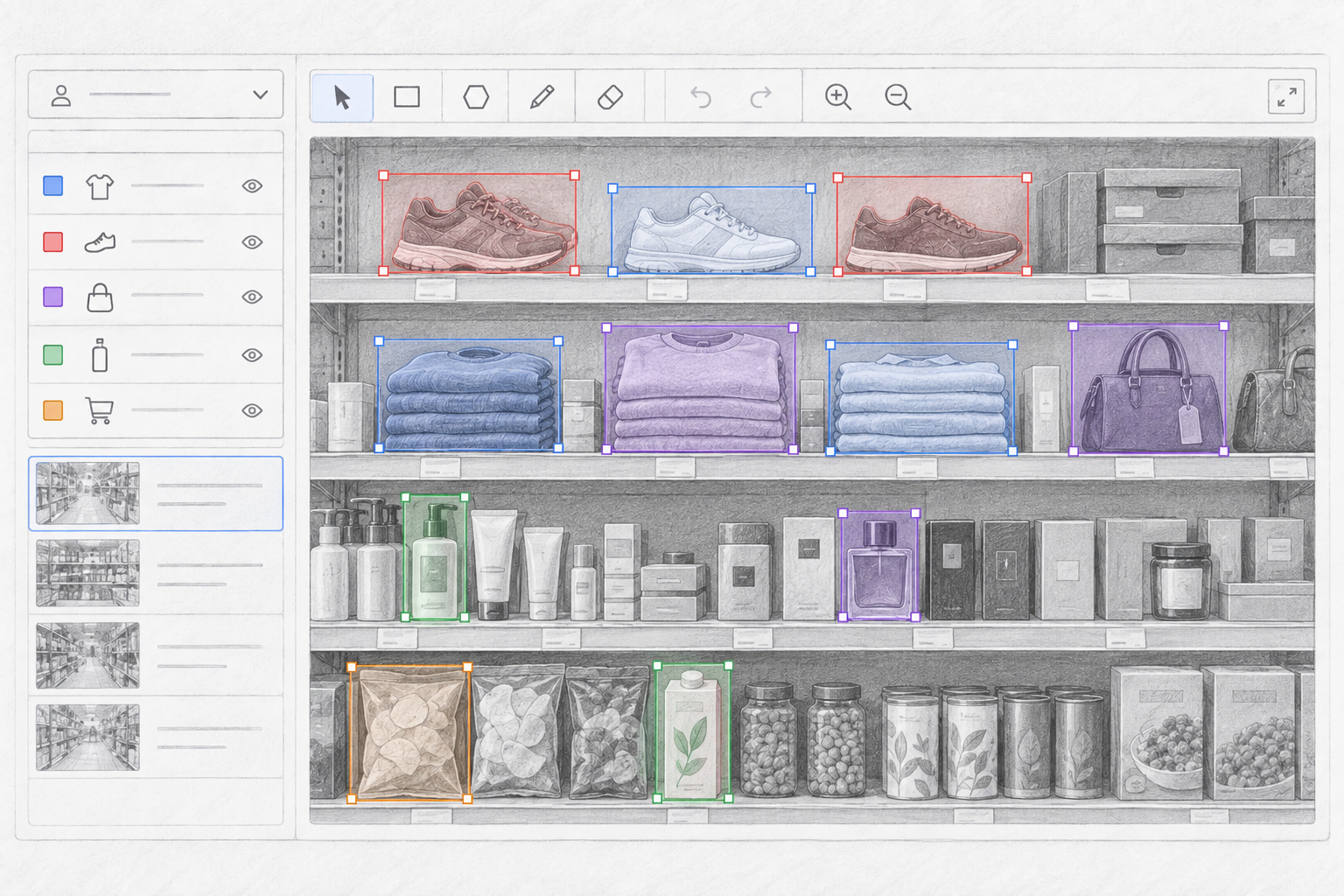
Data annotation for retail and e-commerce is the preparation of images, video, text and product catalogs for training artificial intelligence models.
Depending on the task, annotators mark products in photos, assign categories and attributes, segment individual objects, recognize text on packaging and price tags, or link images to product cards.
These datasets automate shelf analytics, product recognition, assortment control, visual search, product classification and other AI services.
Retail has a large number of similar objects. One category can include hundreds or thousands of SKUs that differ by color, pack size, model or design details.
Training therefore depends not only on volume, but on shared annotation rules, a clear class structure and stable labeling quality.
Bounding boxes for individual products, packs, price tags, logos and other objects. Used for product recognition and automatic shelf-image analysis.
Pixel-perfect or polygon annotation that separates a product from the background. Used in visual search, fashion, catalog generation and computer vision systems.
Assigning categories to images:
Additional characteristics:
Highlighting and recognition of:
Products in store photos and video:
Different annotation types for computer vision tasks
Full data preparation cycle from raw data to model-ready output

How we keep product annotation stable
Retail errors often come from visually similar products, a complex category tree and a large number of attributes.
We lock classification rules before scaling and describe borderline cases separately.
Annotation passes several review levels, with extra attention to class correctness, completeness and consistency across annotators.
Computer vision systems can automatically analyze photos and video from stores.
Training those models requires each product and its position on the shelf to be marked correctly.
US-DATA can annotate:
This annotation is used in merchandising control, automatic store audits and product-availability analysis.
Projects with many categories, products and attributes.
We consider how data structure will affect model training, not only the formal labels.
We follow your taxonomy or help formalize categories and borderline cases before launch.
Images, video, text, product cards and other data can be handled in one project.
Start with a small pilot and increase volume after quality is confirmed.
Multi-step review keeps the same rules across the project.
More accurate product recognition
Correct category and SKU classification
Better visual search
Stable work with large catalogs
A dataset ready for training and testing
Expandable sections with indicative cost tables.
Choose parameters and get instant estimate
* This estimate is not a public offer. Final cost is determined after technical analysis and data review.
Latest materials on data annotation and machine learning
Describe the task and share a data sample — we will estimate complexity, suggest an annotation format and prepare a test batch.
Modern retail and e-commerce rely on artificial intelligence and computer vision. AI models recognize products, analyze shelf layout, automate catalogs, run visual search and extract information from packaging and price tags. Those systems need carefully prepared and annotated data.
US-DATA provides image annotation and other data labeling for retail and e-commerce. We can mark individual products with bounding boxes, polygons and segmentation masks, classify images, assign product attributes and run OCR on packaging and price tags.
One important area is datasets for recognizing products on retail shelves. A single image can contain dozens or hundreds of objects, many of them visually similar. Annotation must set product boundaries, category, brand or SKU consistently, including borderline cases across the whole volume. Precise outlines use image segmentation, and finding a product in the frame uses object detection.
In e-commerce, annotated data supports visual search, catalog building, image classification and product characteristics. This is especially relevant for fashion, marketplaces, FMCG and companies with large catalogs.
US-DATA can join at any stage: a test batch, guideline design, an existing data pool, or scaling a process that already works. Multi-step review and shared rules keep the dataset consistent as volume grows. When a catalog needs separate image classification, class rules are fixed before scaling.
If your project needs retail data annotation, a product dataset, on-shelf recognition, catalog classification or data for an e-commerce AI model, US-DATA will prepare data in the agreed format for training, testing and further use.