
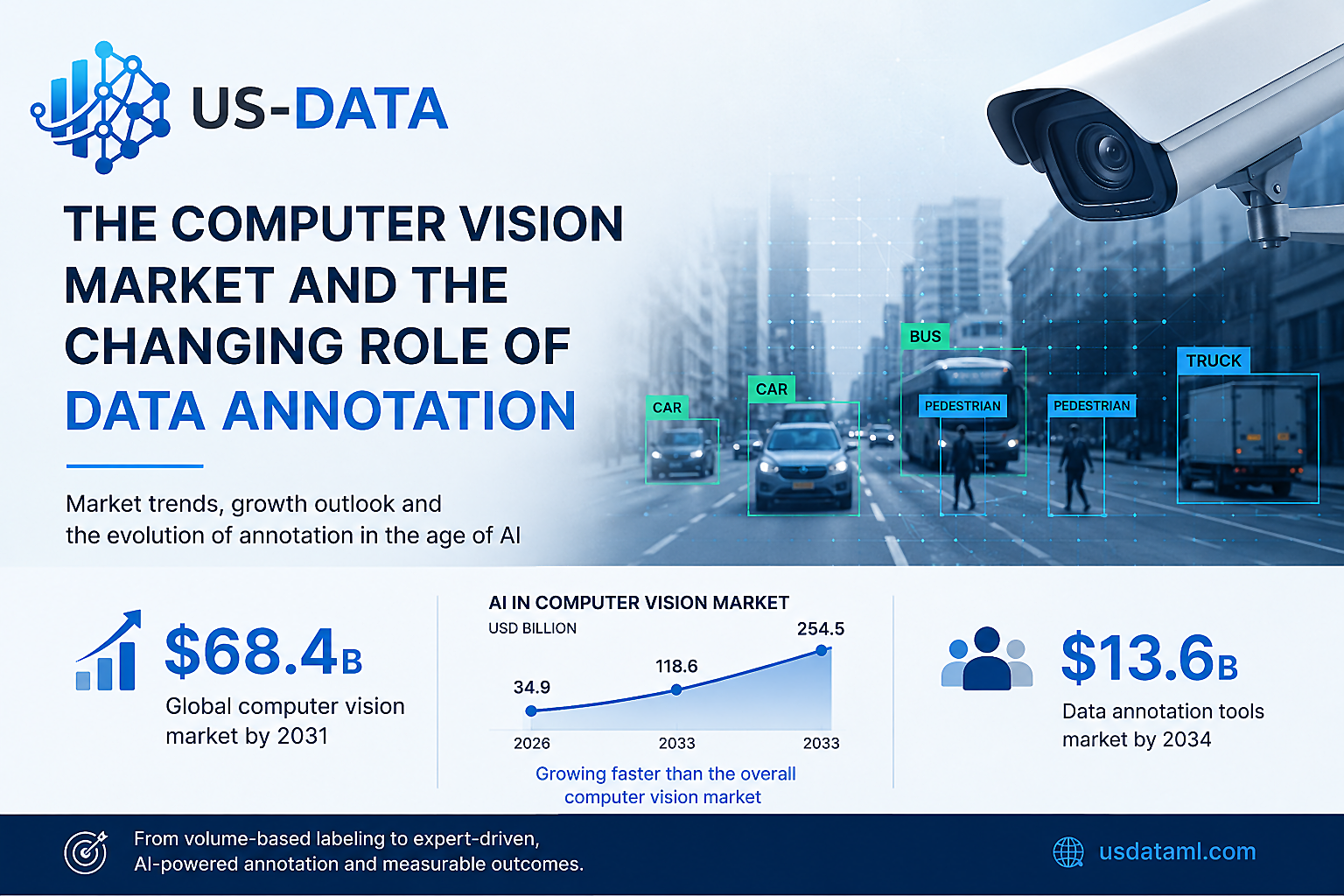
The global computer vision industry continues to grow as businesses expand the use of AI-powered visual systems across manufacturing, logistics, retail, healthcare, transportation, and security. At the same time, another market is developing alongside it — data annotation services and tools. While advances in foundation models, automated labeling systems, and ready-made computer vision APIs have reduced the amount of manual work required for some projects, demand for high-quality annotated data remains strong.
At first glance, this may seem counterintuitive. If modern AI models can already recognize common objects, scenes, and patterns with minimal customization, why are companies still investing heavily in annotation? The answer lies in the changing nature of the work itself. Annotation is not disappearing; rather, its role within the machine learning lifecycle is evolving.
Routine labeling tasks are increasingly being automated through pre-labeling systems, synthetic data generation, and AI-assisted workflows. However, the value of human expertise has shifted toward areas where accuracy, domain knowledge, and quality control have a direct impact on model performance. As a result, the industry is moving away from a volume-based approach toward one focused on data quality and operational outcomes.
Market Growth Continues, Although Forecasts Differ
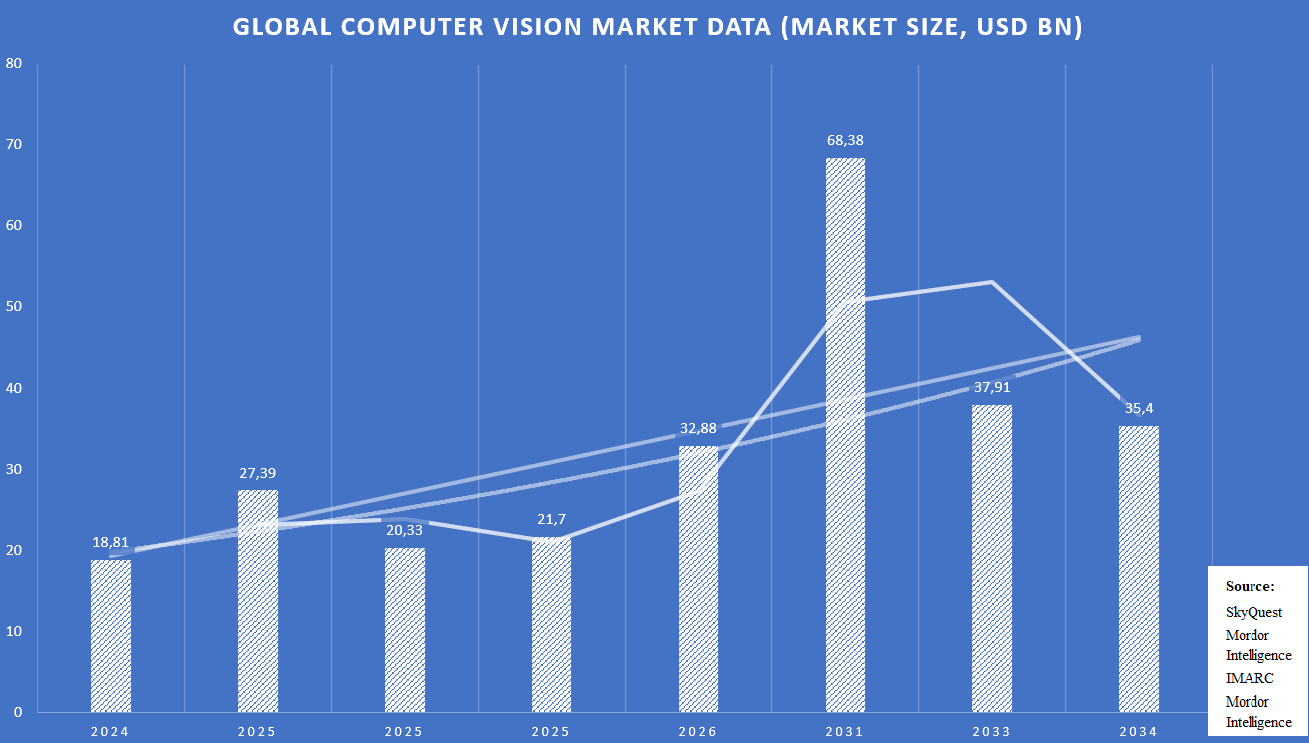
Despite differences in methodology, most industry analysts agree that computer vision remains one of the fastest-growing segments of the AI economy. Market estimates vary depending on how researchers define the boundaries of the sector, but the overall trend is consistent: organizations continue to invest in technologies that enable machines to interpret visual information.
Analysts project sustained growth across industrial automation, intelligent surveillance, retail analytics, transportation systems, robotics, and quality control applications. As visual AI becomes embedded in everyday business processes, demand for both software platforms and supporting data infrastructure is expected to increase.
While the exact market size differs across reports, the broader conclusion remains unchanged. Computer vision is moving from experimental deployments toward large-scale operational use, creating new requirements for reliable training data, continuous model improvement, and ongoing quality assurance.
AI-Powered Vision Systems Are Expanding Even Faster
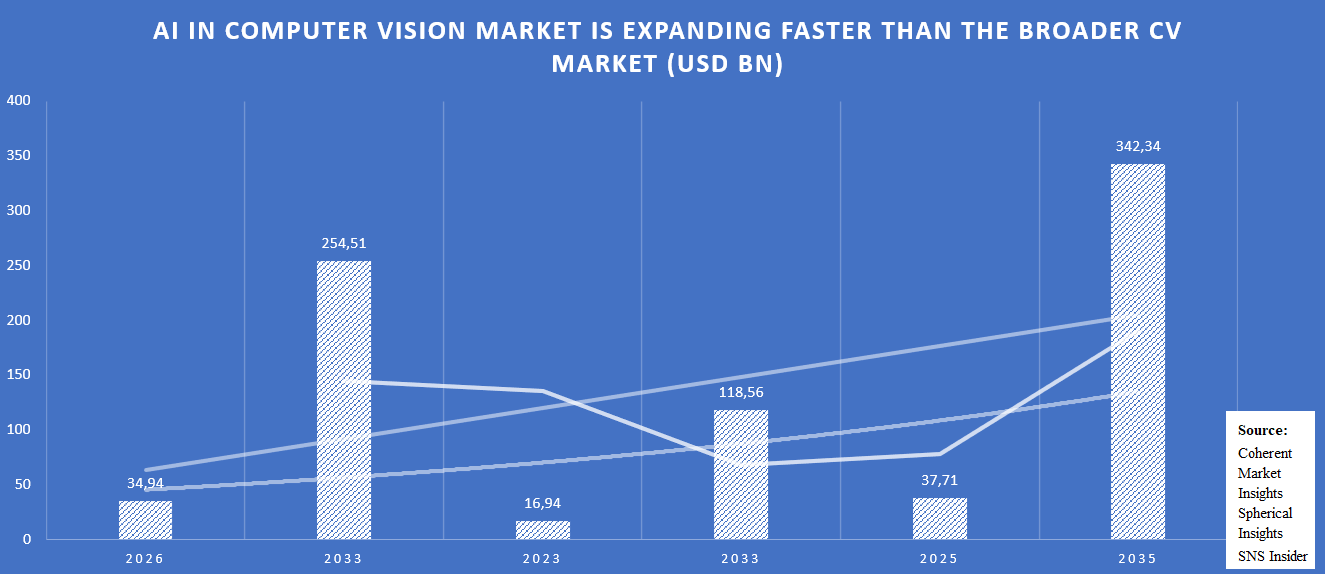
Growth is particularly strong in the segment often described as "AI in computer vision." This category includes advanced perception systems that combine computer vision with foundation models, multimodal AI, and automated decision-making workflows.
Industry forecasts suggest that this segment may grow at a significantly faster pace than the broader computer vision market over the coming decade. The reason is straightforward: businesses are increasingly seeking complete AI-driven solutions rather than standalone image recognition tools.
As adoption accelerates, organizations face a new challenge. Deploying AI models in production requires more than model architecture alone. Success depends on maintaining reliable data pipelines, updating training datasets, monitoring performance, and addressing failures that emerge in real-world conditions. This growing operational complexity is creating additional demand for specialized annotation and data management services.
The Annotation Paradox
The annotation market illustrates an interesting contradiction. On one hand, advances in automation are reducing the amount of manual effort required for many common labeling tasks. On the other hand, spending on annotation services continues to increase.
These two trends are not mutually exclusive. In fact, they are happening simultaneously.
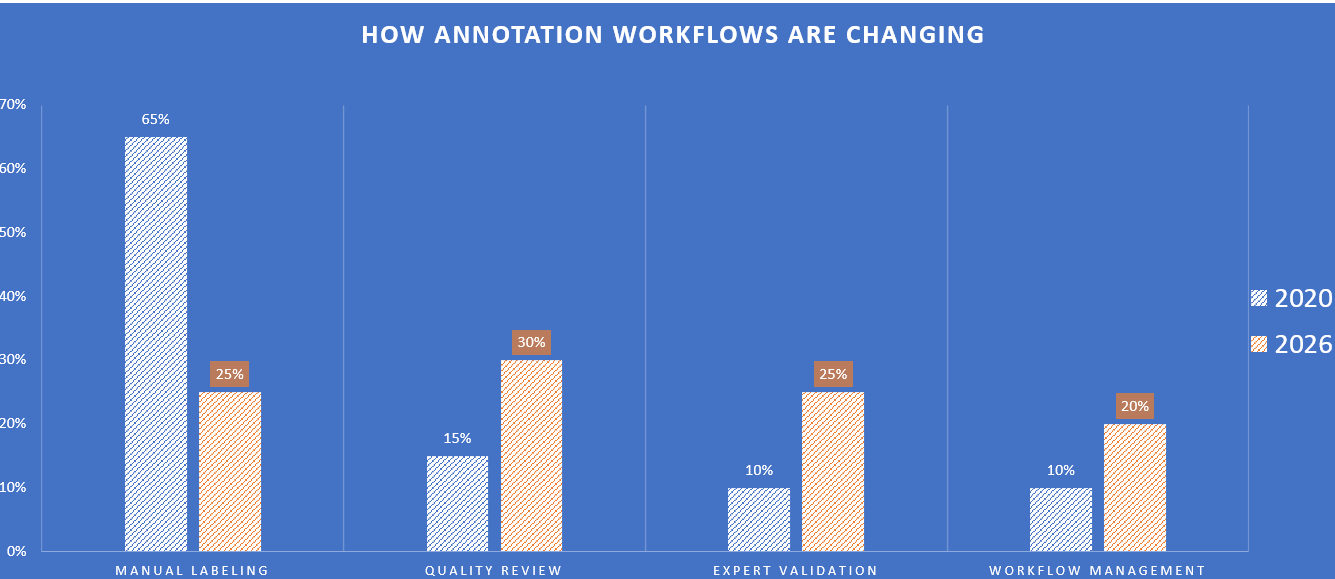
Modern annotation workflows increasingly rely on AI-generated pre-labels that are reviewed and corrected by human specialists. This significantly reduces the time required to process straightforward examples. At the same time, organizations are investing more resources in quality assurance, edge-case analysis, expert validation, and workflow management.
As a result, annotation is becoming less about drawing boxes around objects and more about ensuring that training data accurately reflects real-world conditions. The market is therefore shifting from simple labor-intensive services toward managed workflows that combine automation, human expertise, and quality control.
Industry forecasts for data annotation tools and services support this view. While estimates vary across research firms, most point to strong long-term growth. More importantly, analysts increasingly note that managed services are growing faster than standalone annotation platforms. This suggests that companies are not simply purchasing software; they are looking for partners capable of supporting complex AI development processes.
Why Routine Labeling Is Becoming Less Valuable
For many years, the economics of the annotation industry were relatively straightforward. Companies collected large datasets, hired annotation teams, and scaled projects by increasing the number of people drawing bounding boxes, segmenting objects, or assigning labels.
Today that model is under pressure.
One of the main reasons is the widespread adoption of AI-assisted annotation. In modern workflows, data is increasingly pre-labeled by machine learning models before reaching human reviewers. Instead of creating annotations from scratch, specialists focus on verification, correction, and quality control. As a result, many repetitive tasks require significantly fewer human resources than they did just a few years ago.
Synthetic data is creating similar effects. In industries such as automotive, robotics, and industrial automation, companies increasingly use simulated environments to generate training data. These virtual datasets often include annotations by default, reducing the need for manual labeling under standard conditions.
The growing maturity of foundation models is another factor reshaping the market. For many common computer vision tasks, organizations can now start with pre-trained systems capable of recognizing people, vehicles, products, documents, or other widely represented object categories. This reduces the amount of custom annotation required during the initial stages of development.
Taken together, these trends are transforming annotation from a labor-intensive process into a more specialized function. While automation is reducing demand for basic labeling work, it is simultaneously increasing demand for expertise in validation, quality assurance, and edge-case analysis.
Why Expert Annotation Is Becoming More Important
The decline of routine annotation does not mean annotation itself is becoming less important. In many cases, the opposite is true.
As computer vision systems move into real-world production environments, performance increasingly depends on how models handle unusual, ambiguous, or low-frequency scenarios. These situations often represent a small fraction of the training dataset but account for a disproportionate share of operational failures.
For example, an autonomous vehicle may correctly identify thousands of ordinary road scenes but struggle with unusual weather conditions, damaged road signs, unexpected obstacles, or sensor degradation. In healthcare, AI systems may perform well on common cases yet encounter difficulties when analyzing rare pathologies or borderline findings. Similar challenges appear in industrial inspection, where determining whether a defect is critical often requires domain expertise rather than simple object recognition.
This shift is creating demand for a new category of annotation work. Instead of focusing exclusively on speed and throughput, organizations increasingly prioritize semantic accuracy, consistency, traceability, and expert review.
The annotation process itself is becoming more sophisticated. Projects frequently include pilot datasets, consensus reviews, inter-annotator agreement measurements, escalation procedures for ambiguous cases, and continuous feedback loops between annotation teams and machine learning engineers.
In practical terms, organizations are no longer paying only for labels. They are paying for confidence that those labels accurately represent reality.
Annotation Becomes Part of MLOps
Another important shift is organizational rather than technical.
Historically, annotation was often treated as a one-time project conducted before model training. Once a dataset was completed, attention shifted toward model development and deployment.
That approach is becoming less common.
Modern AI systems continuously generate new data after deployment. Models encounter new environments, user behavior changes, products evolve, and edge cases emerge over time. As a result, datasets require ongoing maintenance rather than one-off creation.
This has led many organizations to integrate annotation directly into MLOps processes. Labels are versioned, quality metrics are monitored, and production data regularly feeds back into retraining pipelines.
Under this model, annotation becomes a continuous operational function. Teams not only create labels but also maintain annotation guidelines, review model failures, identify data gaps, and support iterative improvement cycles.
In mature AI organizations, annotation increasingly serves as a bridge between data collection, model development, deployment, and governance.
The practical implication is significant. Competitive advantage no longer comes solely from having a large dataset. It comes from having a process that allows that dataset to evolve alongside the model.
Regulation Is Raising the Bar for Data Quality
Technology is not the only force reshaping the annotation market. Regulatory requirements are becoming increasingly important, particularly in sectors where AI systems influence decisions related to safety, healthcare, transportation, critical infrastructure, or personal rights.
The adoption of the EU AI Act marks a significant milestone in this process. The regulation introduces requirements for transparency, risk management, documentation, and human oversight in high-risk AI systems. While not every computer vision application falls into this category, the overall direction is clear: organizations will be expected to demonstrate not only how their models perform, but also how those models are developed, monitored, and controlled.
This has direct implications for data annotation.
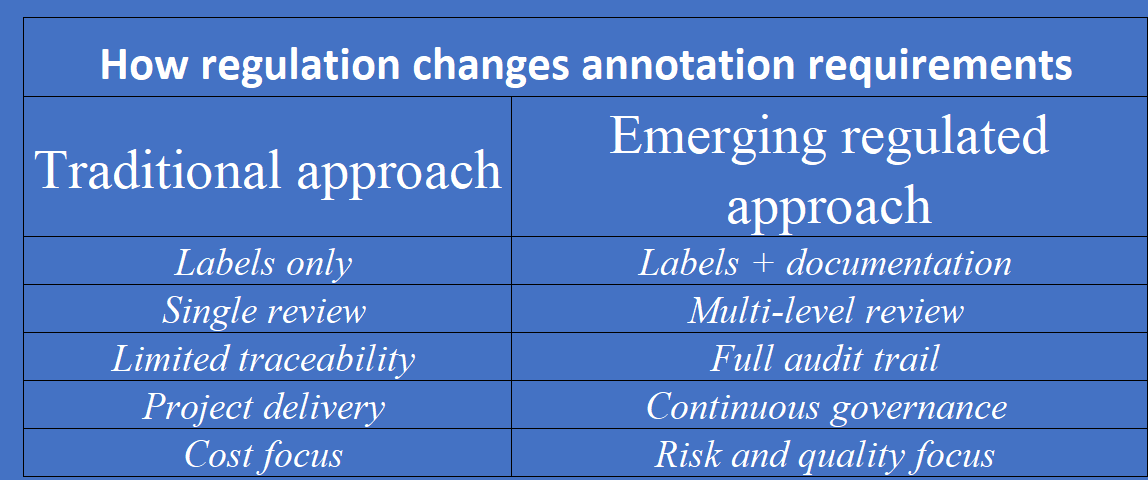
Historically, annotation was often treated as a background operation. Labels were produced, datasets were delivered, and relatively little attention was paid to documenting how decisions were made during the process. Under emerging regulatory frameworks, that approach may no longer be sufficient.
Organizations increasingly need evidence showing how data was prepared, who reviewed it, which quality controls were applied, and how disagreements between annotators were resolved. Traceability, auditability, and documentation are becoming as important as accuracy itself.
For service providers, this creates a new competitive differentiator. Companies capable of delivering structured workflows, documented quality assurance procedures, and transparent review processes are likely to be better positioned than vendors competing primarily on labor costs.
In other words, regulation is accelerating a trend that was already underway: annotation is becoming part of AI governance rather than a standalone operational task.
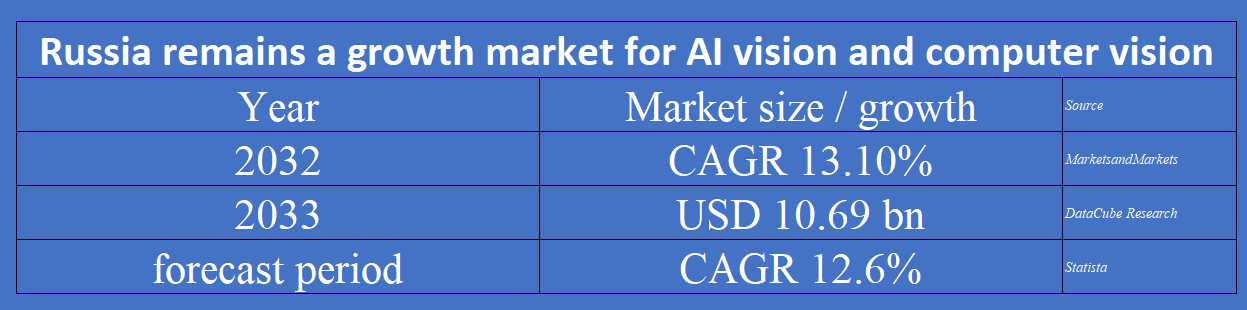
Russia Remains a Growing Computer Vision Market
Although much of the global discussion around AI focuses on North America, Europe, and China, the Russian market continues to demonstrate steady growth in computer vision adoption.
Industry forecasts indicate sustained demand across surveillance systems, industrial automation, logistics, smart city projects, and manufacturing. Security applications remain one of the largest segments, but investment is increasingly expanding into production monitoring, predictive maintenance, and automated quality control.
Several factors contribute to this trend. Organizations are seeking greater operational efficiency, while at the same time prioritizing local infrastructure and domestic technology ecosystems. These considerations often increase the importance of regionally adapted datasets and locally managed data workflows.
For annotation providers, this creates opportunities beyond simple localization. Computer vision systems frequently require adaptation to specific environments, operational procedures, and regional conditions. As a result, annotation projects increasingly involve custom taxonomies, domain-specific guidelines, and datasets tailored to local deployment requirements.
While Russia represents only one part of the broader global market, its development illustrates a wider pattern: as AI adoption spreads across industries, demand for specialized data services continues to grow alongside it.
Recent Industry Signals
Several developments during 2026 help illustrate the direction in which the market is moving.
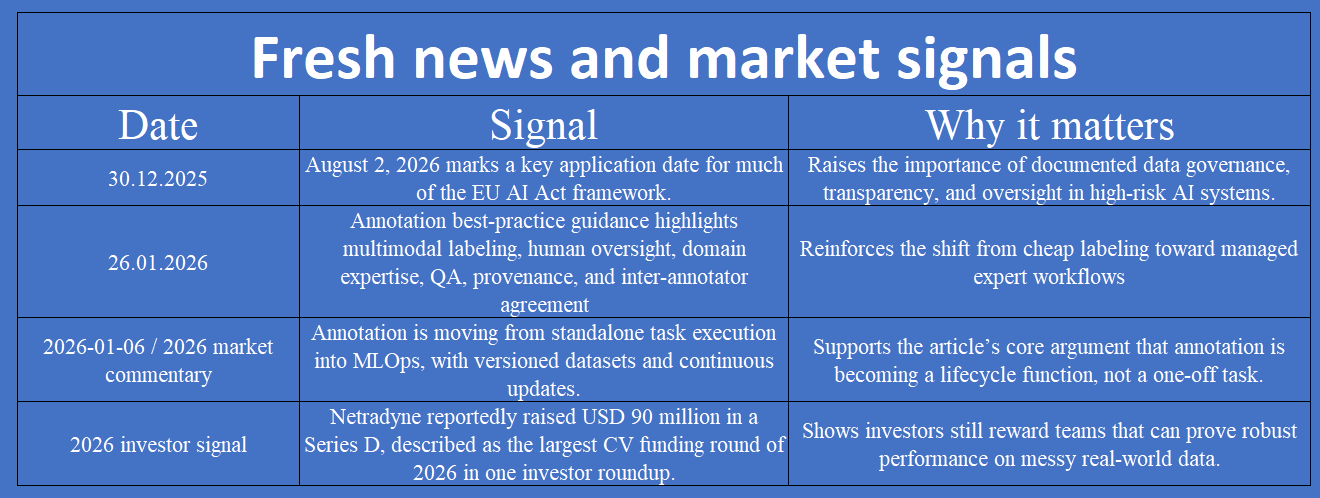
First, the approaching implementation milestones of the EU AI Act have pushed many organizations to reassess their AI governance practices. Human oversight, documentation, and accountability are increasingly being discussed not only by regulators but also by technology vendors and enterprise buyers.
Second, conversations within the annotation industry itself have shifted noticeably. A few years ago, most discussions focused on scale: how many images could be labeled, how quickly projects could be completed, and how labor costs could be reduced. Today, industry participants are increasingly focused on edge-case coverage, annotation quality, expert review, and integration with broader AI development workflows.
Third, investor activity suggests that the market continues to reward companies capable of delivering measurable real-world performance. In computer vision, successful deployments are rarely determined by model architecture alone. Data quality, training methodology, and the ability to continuously improve performance remain critical factors.
Taken together, these signals suggest that the market is entering a more mature phase. Growth remains strong, but competitive advantage increasingly depends on operational excellence rather than simply access to technology.
What This Means for Service Providers
For annotation companies and data service providers, the implications are becoming increasingly clear.
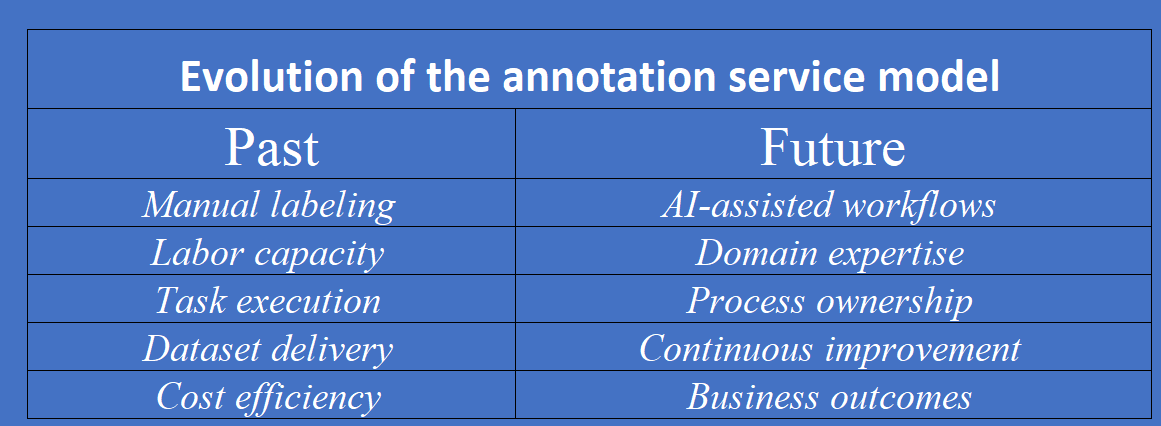
The traditional business model built around large volumes of low-cost manual labeling is facing mounting pressure from automation. Pre-labeling systems, foundation models, and synthetic data generation are steadily reducing the amount of routine work that requires human intervention.
However, automation is not eliminating demand. Instead, it is changing where value is created.
Organizations increasingly need partners capable of designing annotation strategies, building quality assurance frameworks, validating difficult cases, managing expert review processes, and supporting long-term model improvement. These capabilities are considerably harder to automate than basic labeling tasks.
As a result, the strongest providers are evolving beyond the role of workforce suppliers. They are becoming operational partners embedded within customers' machine learning workflows.
This shift mirrors developments seen in other technology sectors. As tools become more powerful and accessible, differentiation moves away from software itself and toward expertise, process design, and execution quality.
Annotation appears to be following the same path.
Conclusion
The computer vision market continues to expand, and the annotation industry is growing alongside it. What is changing is not the need for annotated data, but the nature of the work that creates value.
Routine labeling tasks are increasingly automated through AI-assisted workflows, synthetic data generation, and foundation models. At the same time, demand is rising for expert annotation, quality assurance, governance processes, and workflow integration.
This shift reflects a broader maturation of the AI industry. As organizations move from experimentation to production deployment, success depends less on the quantity of data and more on its quality, consistency, and relevance to real-world conditions.
For enterprise buyers, the key question is no longer whether annotation is necessary. The more important question is which parts of the annotation process can be automated and which require human expertise, domain knowledge, and structured oversight.
The answer to that question is likely to shape the next generation of computer vision projects.
Repetitive constructions have been reduced, arguments are presented more sequentially, and statistics support the narrative rather than dominate it. The overall tone now resembles a market analysis published by a consulting firm, research agency, or industry publication.
Sources and References
- Mordor Intelligence. Computer Vision Market Size, Share & Growth Trends, 2025–2031.
- IMARC Group. Computer Vision Market Size, Share & Industry Report, 2025–2034.
- SkyQuest Technology. Computer Vision Market Forecast and Analysis.
- Coherent Market Insights. AI in Computer Vision Market: Global Forecast, 2026–2033.
- Spherical Insights. AI in Computer Vision Market Size and Growth Outlook.
- IMARC Group. Data Annotation Tools Market Size & Forecast to 2034.
- Mordor Intelligence. Data Annotation Tools Market – Industry Analysis.
- Precedence Research. AI Annotation Market Size and Forecast to 2034.
- Humans in the Loop. Data Annotation Trends 2026: Forecast and Best Practices.
- Annotera. The Future of Data Annotation: Key Trends for 2026.
- MarketsandMarkets. Russia AI Vision Market Forecast.
- DataCube Research. Russia AI Computer Vision Market Outlook.
- Statista. Computer Vision Market Forecast in Russia.
- European Union. EU AI Act, Article 14 – Human Oversight Requirements.
- Pearl Cohen. Guidance on the EU AI Act and Upcoming Enforcement Milestones.
- Industry funding reports and public investment announcements in the computer vision sector, 2025–2026.
- US-DATA. Internal project experience, computer vision annotation workflows, quality assurance methodologies, and operational practices in data annotation for machine learning.
Website: https://usdataml.com/
This article includes market research from publicly available industry reports and expert commentary. Certain observations regarding annotation workflows, quality assurance processes, MLOps integration, and enterprise implementation practices are based on the practical experience of US-DATA in delivering data annotation services for computer vision and machine learning projects.