
What Is Data Annotation and Why It Matters
Data annotation is the interpretation layer between raw data and a machine learning model. As long as an image, text, audio recording, or video stream has no clear structure, for the algorithm it is just a set of signals: pixels, tokens, amplitudes, time segments. Annotation is what turns this “raw stream” into a training dataset that a model can use to discover patterns and learn how to make decisions.
Put simply, annotation tells the system what exactly it is looking at. Not “an image 1024×768”, but a car in a specific area of the frame. Not “a line of characters”, but a customer complaint, a date, a brand name, or an address. Not “an audio file 37 seconds long”, but speech from two speakers with pauses, changes in intonation, and specific utterances. The quality of this layer has a huge impact: if the training data is labeled carelessly, even a strong model architecture will quickly hit a ceiling in terms of performance.
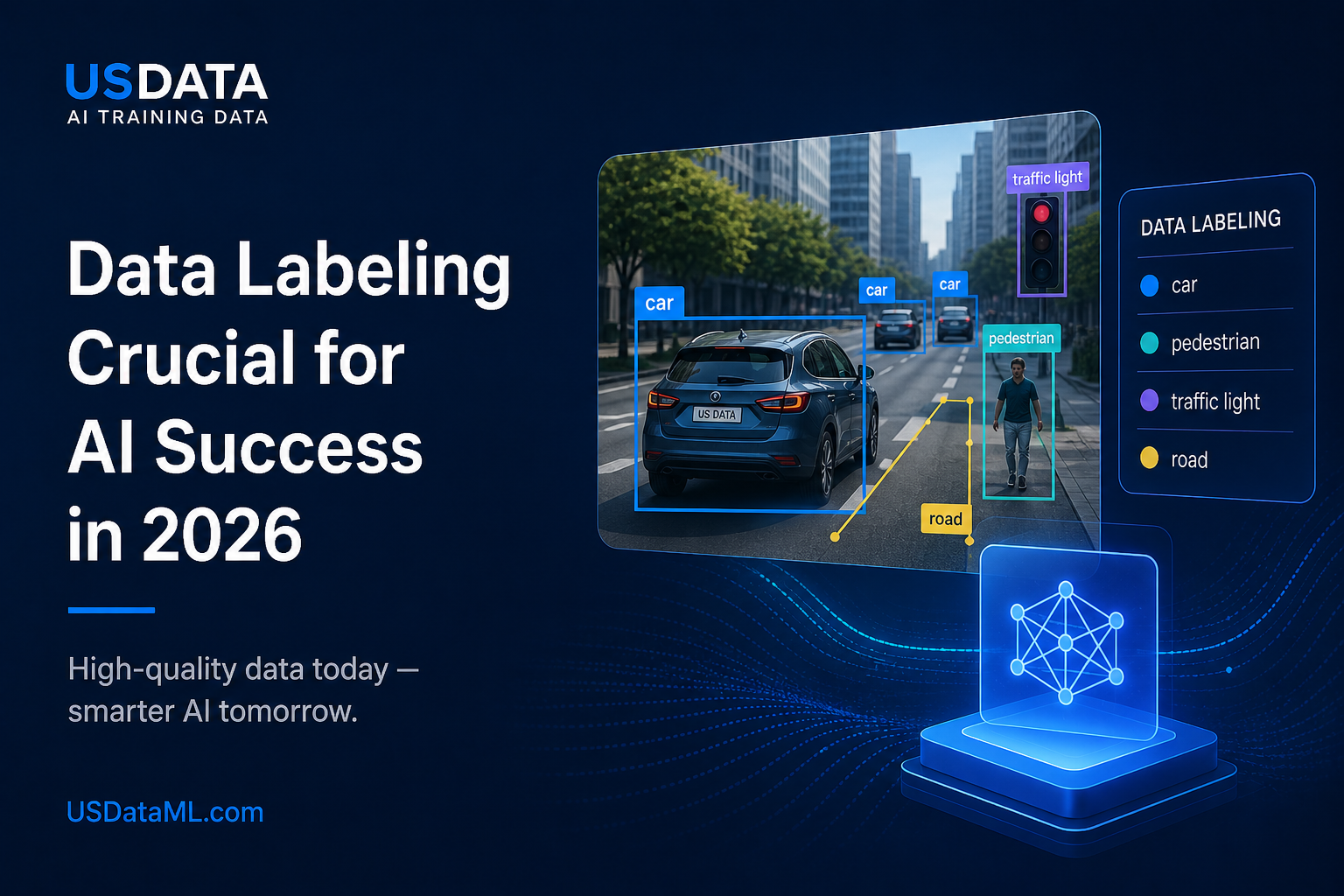
Take the task of vehicle detection as an example. Simply uploading thousands of images into the pipeline is not enough. For every frame you need to specify where exactly the object is located, which class it belongs to, and, in many scenarios, refine its shape, key points, or pixel mask. Without this preparation, the neural network does not “see” a car as an entity — it only operates on numbers with no context. This is why, in real-world ML projects, annotation quality often affects the final result just as much as, or even more than, the choice of model architecture.
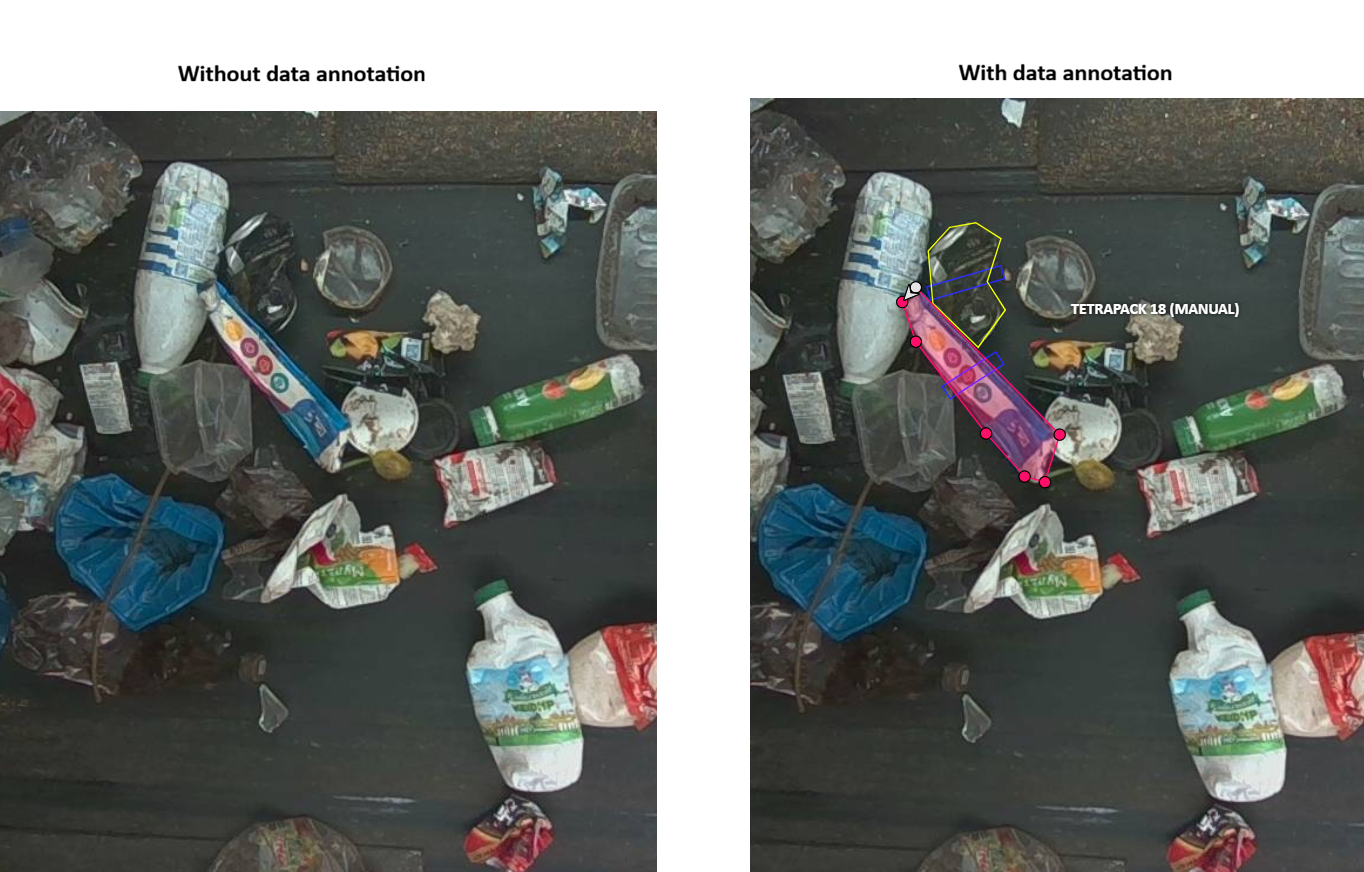
For computer vision tasks, specific annotation formats and examples can be found on the image annotation page .
Main Types of Data Annotation
The type of annotation is never chosen “by habit”, but according to the specific ML task, data modality, and acceptable error cost. The same dataset can be annotated in different ways: quickly and roughly to get a baseline model, or deeply and meticulously if high production accuracy is required.
In practice, annotation is usually split into four major groups: images, text, audio, and video. These are exactly the data types US-DATA works with.
Image Annotation
Image annotation is required anywhere a model needs to understand a visual scene: in computer vision systems, industrial analytics, retail, security, transportation, and medical tech. On the US-DATA image annotation page you will find the key formats: bounding boxes, polygons, masks, keypoints, classification, and captioning.
Bounding Boxes
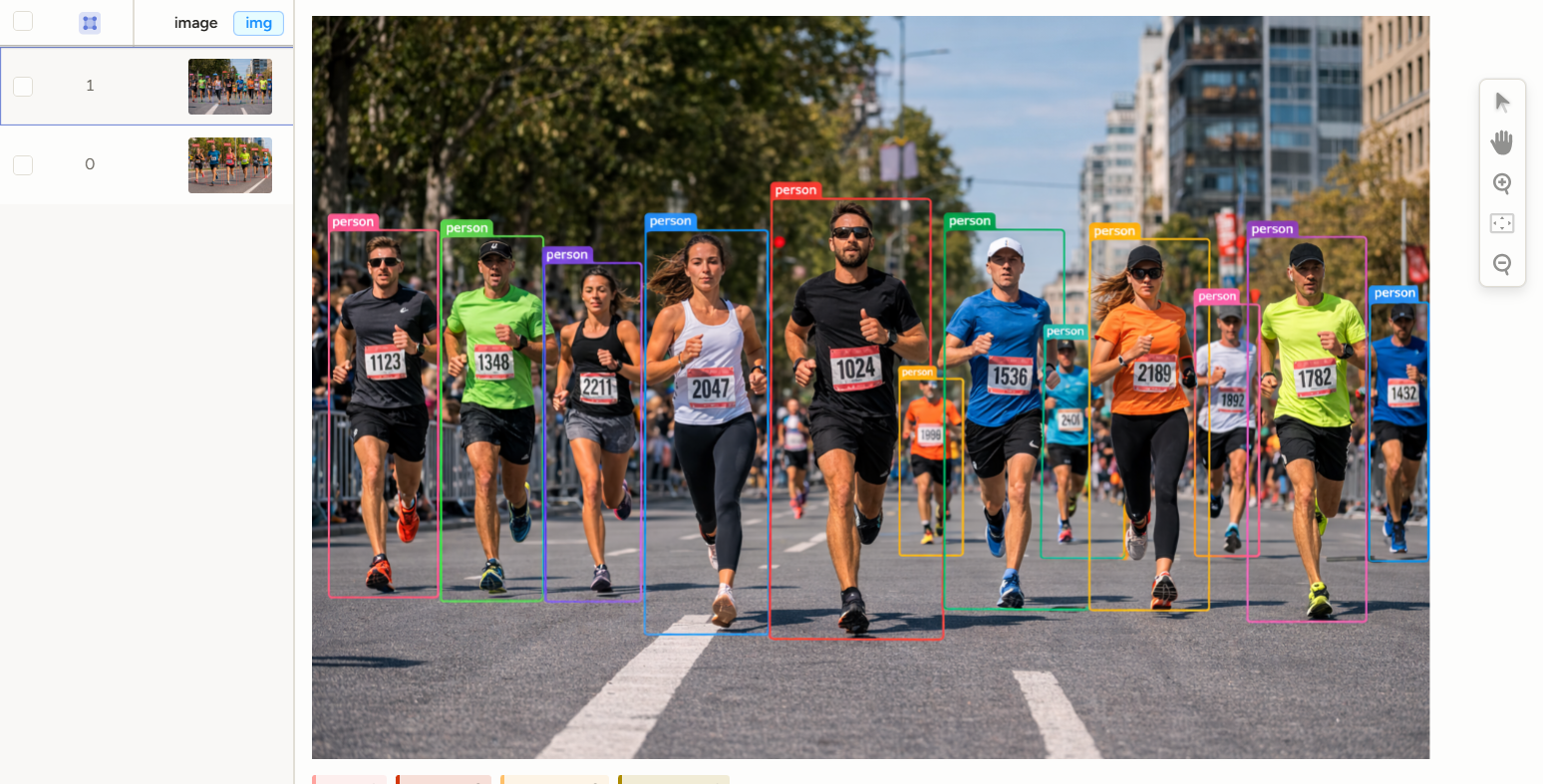
A bounding box is the basic format for object detection. The annotator draws a rectangular box around an object, specifying its location in the frame. This approach works well when the system needs to know that an object is present and where it is located approximately, without pixel-perfect contours.
Bounding boxes are typically used for:
- detecting vehicles and road objects;
- detecting people;
- finding products on images;
- video surveillance;
- initial training of object detection models.
The main advantage is clear: it is fast, scalable, and relatively inexpensive. The downside is also obvious — a rectangle almost always includes extra background, so accuracy on complex shapes is limited.
Polygon Annotation
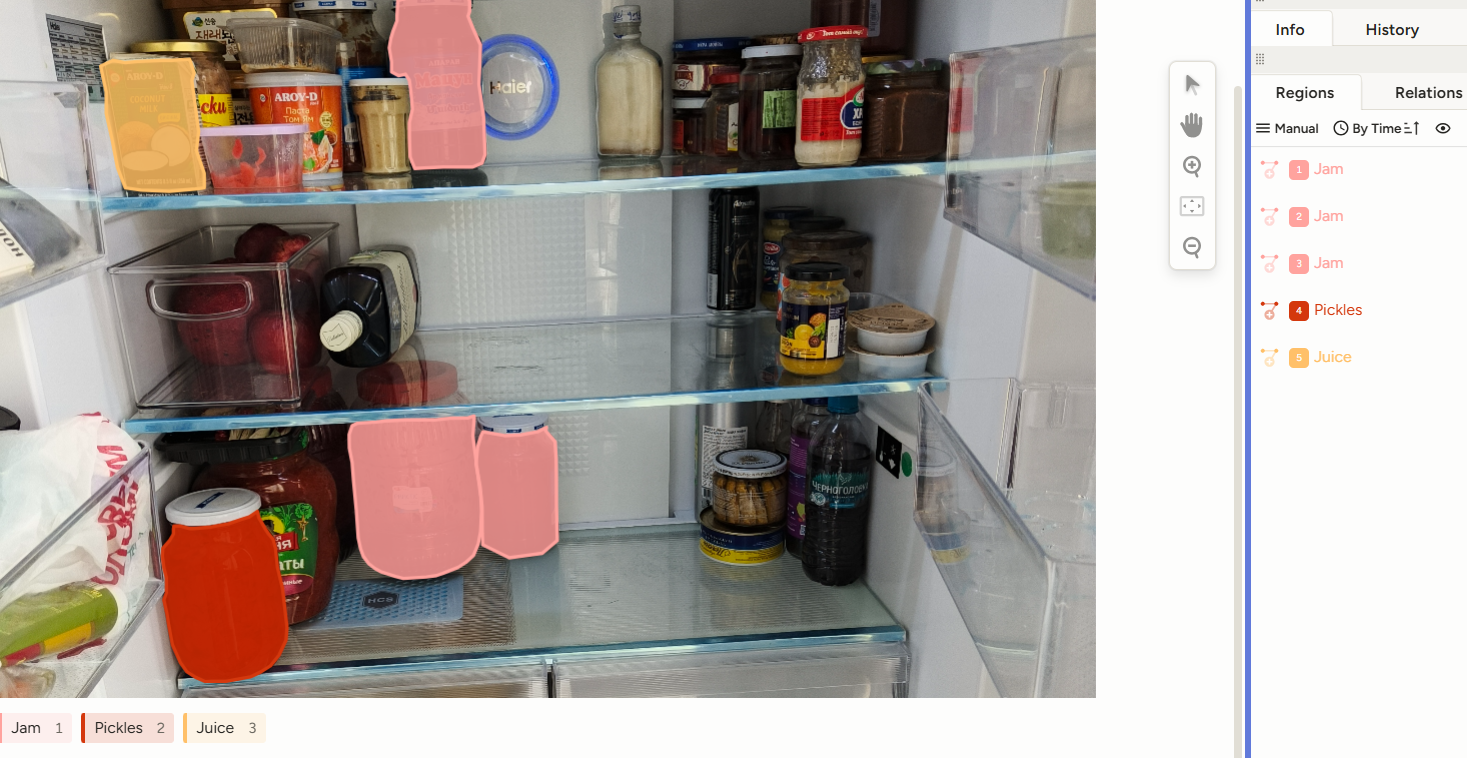
Polygon annotation is used when a rectangle cannot adequately describe an object. The annotator manually places points along the contour and forms a polygon that follows the object’s shape much more precisely.
This format is used for:
- medical images;
- industrial defect inspection;
- annotating complex objects on satellite imagery;
- cases where background noise must be minimized for the model.
Polygon annotation is more time-consuming to produce, but it gives the model a much cleaner geometry of the object. For segmentation and contour-sensitive tasks this is often not a luxury, but a requirement.
Semantic Segmentation
Semantic segmentation is pixel-level annotation. Every pixel receives a class label, and the model begins to understand the scene much more deeply: not just “there is a car somewhere here”, but which exact areas belong to the road, pedestrian, building, or vehicle.
This format is used in:
- autonomous driving;
- robotics;
- medical imaging;
- satellite analytics;
- high-precision computer vision systems.
It is one of the most resource-intensive annotation types, but also one of the most valuable when the model needs dense information about the scene.
Key Point Annotation
In many tasks, the system does not need the entire object, but its key points. These can be a human skeleton, facial landmarks, joints, animal pose elements, or characteristic points of an industrial part.
This approach is used for:
- pose estimation;
- motion capture;
- face analysis;
- motion tracking;
- biomechanics and sports analytics.
For more details on image annotation formats and supported dataset structures, check the US-DATA image annotation page .
Text Annotation
Text annotation is a core element for NLP systems: chatbots, search engines, ticket classifiers, recommender systems, and LLM pipelines. On the main US-DATA website, text is listed as one of the supported data formats. The dedicated page for this direction is text annotation .
Text Classification
The most straightforward scenario is assigning one or more classes to a text. For example, deciding whether an email is spam, assessing the sentiment of a review, or classifying a document as legal, financial, or technical.
This type of annotation is used when the system must quickly make an applied decision: route a request, filter content, flag risky messages, or group documents by type. The simplicity is deceptive: even basic classification requires clear guidelines, otherwise the model ends up learning from inconsistent examples.
Named Entity Recognition (NER)
NER is the annotation of named entities within text. The system learns to highlight specific semantic elements rather than the whole document: person names, organizations, dates, amounts, locations, brands, contract numbers, and other attributes.
For example, in the sentence “Ivan Petrov has been working at Yandex since 2023”, the entities PERSON, COMPANY, and DATE can be annotated. For enterprise systems this layer is crucial: it enables automated fact extraction, retrieval of key fields, and building structured layers on top of unstructured text.
Intent Annotation
Intent annotation is used in dialog systems. Here it is important not just to understand the user’s words, but to identify their intent: place an order, check delivery status, cancel a subscription, or request support.
When intents are well annotated, the bot works noticeably better: it makes fewer routing errors and gets users to the desired action faster. For e-commerce, fintech, and customer service this is one of the most practical text annotation formats.
Audio Annotation
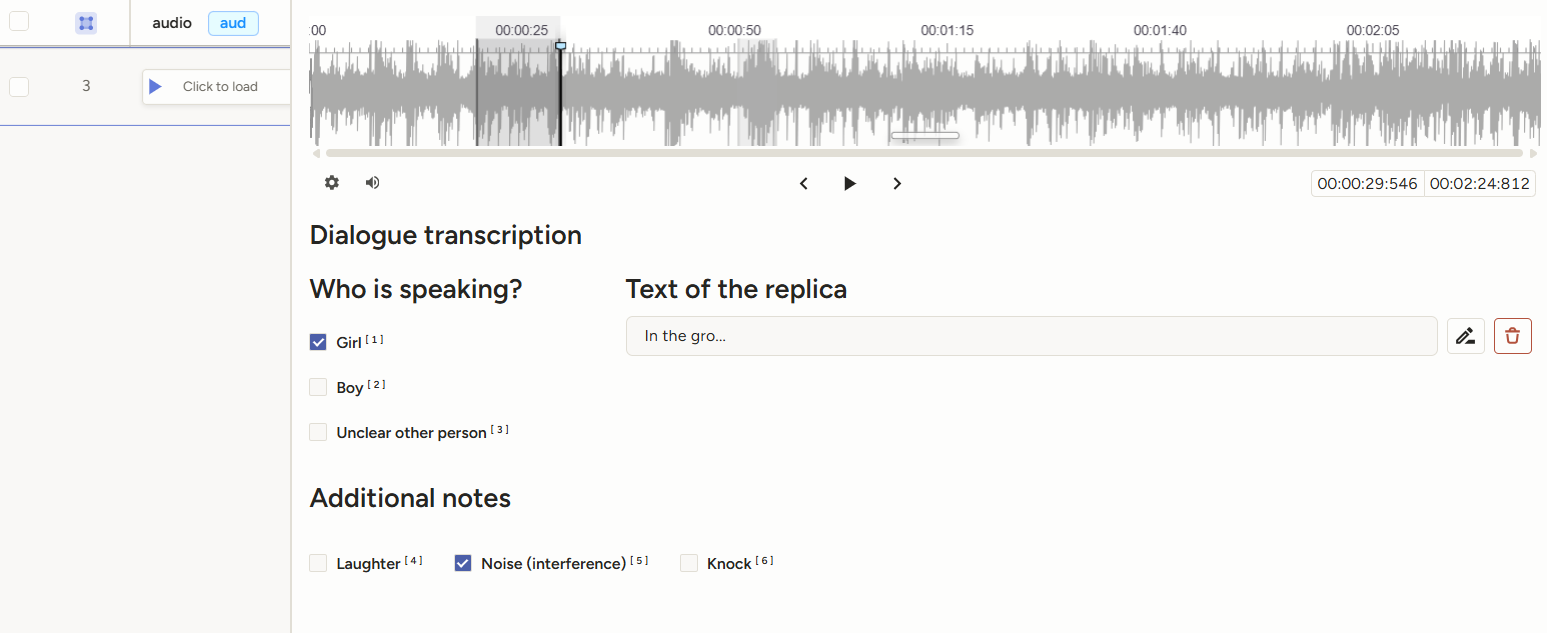
Audio annotation is needed wherever models work with speech, voice interfaces, calls, podcasts, and multichannel recordings. The details of these services can be presented on a dedicated audio annotation page .
Speech Transcription
The basic layer of audio annotation is transcription — converting speech into text, often with timestamps. Such data is used by voice assistants, call centers, subtitling systems, speech analytics, and audio search.
If the transcript contains errors, all higher-level models — from intent detection to voice analytics — begin to degrade. That is why even “simple” speech-to-text in practice requires strict guidelines, QA, and unified instructions.
Speaker Diarization
Speaker diarization is speaker-level annotation, i.e., tracking who is speaking at each moment in time. In multi-speaker recordings, without this layer a model cannot understand the structure of the dialogue: utterances blend together and analytics loses accuracy.
This format is especially useful for business calls, interviews, podcasts, court and official recordings, and conversation analytics.
Emotion Annotation
Another layer is emotion in speech. The annotator marks where irritation, neutrality, joy, tension, or other states are audible. This type of annotation is needed when the system must analyze not only the meaning of a phrase, but also the emotional context of the conversation.
Video Annotation
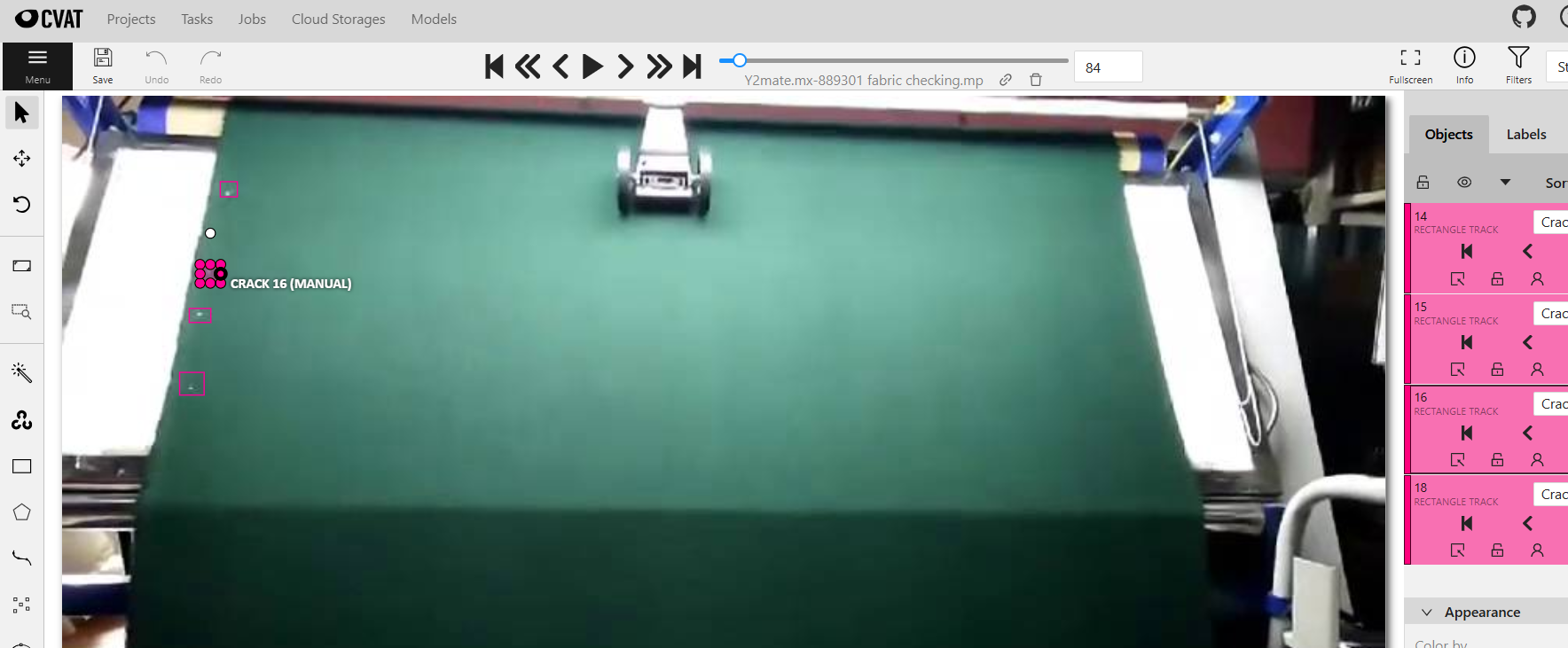
Video annotation combines spatial and temporal logic. It is not enough to understand what is in the frame — the system must also account for how an object moves, when an action starts, where a scene changes, and how context evolves over time. A dedicated page for this direction can be presented as video annotation .
Object Tracking
Object tracking is about following an object across frames. The model learns to recognize that the same object preserves its identity over time, even when viewpoint, lighting, or partial occlusion change.
Tracking is used in video surveillance, sports analytics, autonomous vehicles, logistics, and systems that monitor flows of people and traffic.
Temporal Segmentation
Temporal segmentation means splitting a video into meaningful intervals. For example, annotators can mark the start and end of an action, scene changes, key events, operation phases, or individual steps in a user scenario.
Types of Annotation by Execution Method
Annotation differs not only by data type, but also by how it is produced. In practice, three main schemes are used: manual, semi-automatic, and automatic.
Manual Annotation
Here, annotation is carried out by a human without relying on model predictions. This approach is costly and slow, but it provides maximum accuracy for complex cases and edge scenarios.
Advantages:
- high accuracy;
- flexibility;
- correct handling of non-standard cases.
Limitations:
- high cost;
- long turnaround times;
- dependence on guideline quality and QA.
Semi-Automatic Annotation
In this scheme, part of the work is done by an algorithm, and a human verifies and corrects the output. This is an optimal choice for large datasets when the pipeline must be accelerated without a dramatic loss in quality.
This approach is especially useful if the project already has an initial model or pre-labeling system that can be used as a rough first layer before human validation.
Automatic Annotation
Automatic annotation is performed almost entirely by algorithms. It is typically applied to initial labeling, processing of huge data volumes, or synthetic data pipelines.
However, without subsequent validation, the quality of such a dataset can rarely be considered production-ready. Automatic annotation works well as an accelerator, not as a full replacement for human input.
How to Choose the Right Type of Annotation
The choice depends on several parameters at once, and a mistake at this stage can be very costly later.
-
Project goal.
If the task is only to detect the presence of an object, bounding boxes are often enough. If exact contours matter, it is better to look towards polygon annotation or segmentation from the start. -
Budget.
The deeper and more precise the annotation, the higher the cost — including manual work, QA, and guideline preparation. -
Accuracy requirements.
For healthcare, autonomous driving, industrial diagnostics, and other safety-critical domains, coarse annotation is not an option because the cost of error is too high. -
Data volume.
For large datasets, hybrid setups are usually more effective: auto-labeling followed by human validation and control samples.
Common Data Annotation Pitfalls
Even a well-chosen annotation type will not guarantee success if the process itself is poorly organized.
Inconsistent Annotation
When different annotators label similar cases in different ways, the model receives a contradictory training signal. This is one of the most frequent sources of quality degradation.
Poor Guidelines
If the rules are vague, the team starts interpreting ambiguous cases in its own way. As a result, variance between annotators grows, and with it the noise in the dataset.
Data Bias
If real usage scenarios are not represented in the dataset, the model will be unstable in production. This is especially evident in rare classes, “long tail” cases, and non-standard recording, imaging, or phrasing conditions.
Why Choosing an Experienced Annotation Partner Matters
An annotation provider is not just an external “manual labor” resource. In practice, it is a part of the ML loop that determines what the training set will look like and how quickly the team will reach a working solution.
When choosing a vendor, it is worth evaluating:
- experience with different data types;
- presence of a formalized QA process;
- ability to scale the team;
- understanding of ML specifics;
- ability to integrate into the client’s workflow;
- security of data storage and processing.
US-DATA as a Data Annotation Partner
US-DATA positions itself as a data annotation service for machine learning and works with images, text, audio, and video. The website also highlights core tasks such as object detection, segmentation, landmarks, and classification.
This is convenient for businesses for two reasons. First, clients do not just get “manual labeling”, but a service familiar with standard ML pipelines and dataset structures. Second, test annotation, supervision, and delivery of a finalized dataset after QA are specifically emphasized — critical for projects where annotation quality directly affects model metrics.
For quick access to services, use the following pages:
What Businesses Ultimately Gain
Data annotation is not a secondary operation and not just a mechanical prep step before training. It is one of the foundational layers of any AI/ML system, defining how well the model can see, distinguish, classify, and interpret input data.
As models become more complex, their data requirements grow as well. A good dataset today is not just a large volume of information, but precise, consistent, and well-governed annotation, built into a robust production process. This is exactly where a strong data annotation partner creates real value.