
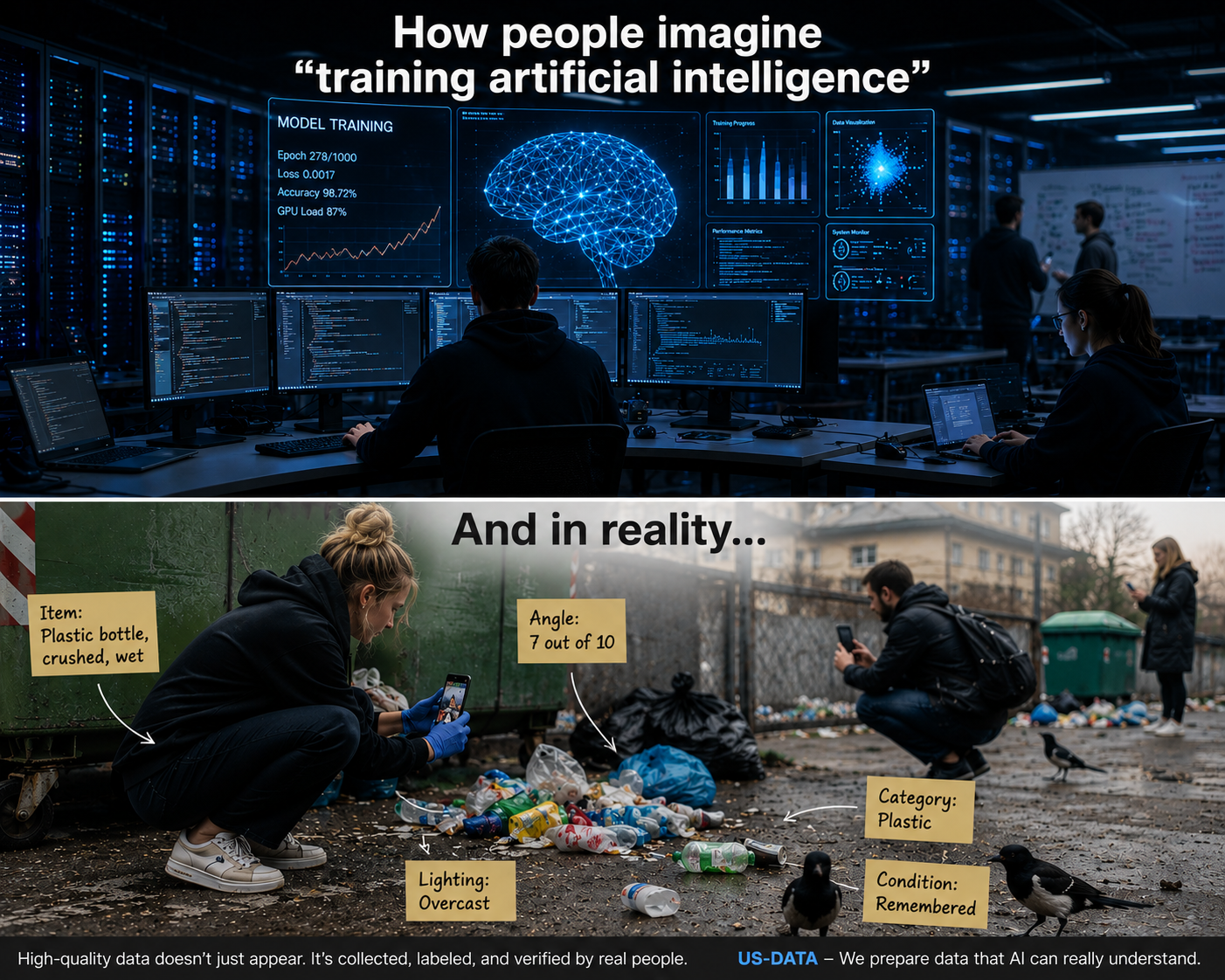
Data Annotation for AI: Why Annotators Don’t Always Work Behind a Computer — US-DATA Waste Sorting Case Study
Computer vision models only perform well when they are trained on high-quality and relevant datasets. In real-world AI projects, data quality often becomes the biggest challenge.
One of these challenges appeared during a waste sorting automation project. Initially, the neural network was trained using publicly available and foreign datasets. However, once tested in real urban environments, the model produced a large number of errors.
The system struggled to recognize deformed packaging, confused wet plastic bags with glass, and performed poorly in overcrowded waste containers and difficult lighting conditions.
Why Existing Datasets Were Not Enough
Most open datasets did not reflect real-world conditions. They lacked local packaging variations, damaged objects, dirt, weather effects, and realistic waste disposal scenarios.
For the model, a clean plastic bottle from a dataset and a crushed bottle lying outside after rain could appear as completely different objects.
It became clear that the project required a new dataset collected specifically for real operating conditions.
How US-DATA Solved the Problem

US-DATA organized the full data preparation pipeline for model training:
- real-world image collection;
- waste category structure creation;
- object annotation;
- quality assurance processes;
- dataset preparation for machine learning training.
The task was more complex than a standard object recognition project. The AI model needed not only to identify waste categories but also to understand object positioning and orientation.
This is critical for robotic waste sorting systems where a machine must determine how to correctly grab and move an object using robotic manipulators.
Collecting Real-World Training Data
Part of the dataset had to be collected manually in urban environments: near stores, waste collection areas, and public trash container sites.
The team captured objects under different conditions:
- crushed plastic bottles;
- damaged packaging;
- partially hidden objects;
- overfilled waste containers;
- poor weather and lighting conditions.
These variations helped create a more realistic and robust training dataset for computer vision systems.
Project Results
As a result, the project received a specialized dataset adapted to real operating conditions. This significantly improved recognition accuracy and reduced the number of AI prediction errors outside controlled testing environments.
Today, datasets like these are becoming essential for automated waste sorting, environmental monitoring systems, robotics, and industrial AI applications.
Data Annotation Services for AI Projects
US-DATA provides professional data annotation and dataset preparation services for machine learning projects, including computer vision, text processing, audio annotation, and video labeling.
Our team helps companies build datasets suitable not only for testing but also for production-level AI systems.
Learn more about US-DATA services: